THE ATHLETE'S GAMBLE: WEIGHTLIFTING
There is no question the greatest athlete to ever walk the planet is fellow Auburn University alum Vincent "Bo" Jackson.
At 6'1" and 230 LBS of chiseled granite, he was dominant in not one, but two professional sports.
He did things you had to see to believe; he is a living legend.
But there was one thing he never did.
Lift weights.
He went to practice. He played the game. His natural physical talent was good enough.
Now, to be clear, this isn't going to be a rant against weight lifting.
I do believe athletes can benefit from it. However, at best it comes up short on maximizing neuromuscular benefit. At worst it comes with a high orthopedic price to pay that doesn't optimize readiness on game day, or necessarily benefit the longevity of athletic performance.
Seventy years ago coaches were adamantly opposed to their athletes weight lifting. Now it's a requirement. Yet the debate has continued all these years: do athletes need to lift weights?
Hmmm. Need to? Probably more like have to. Everyone else is. It's not only part of the game. It's part of the business side of the game.
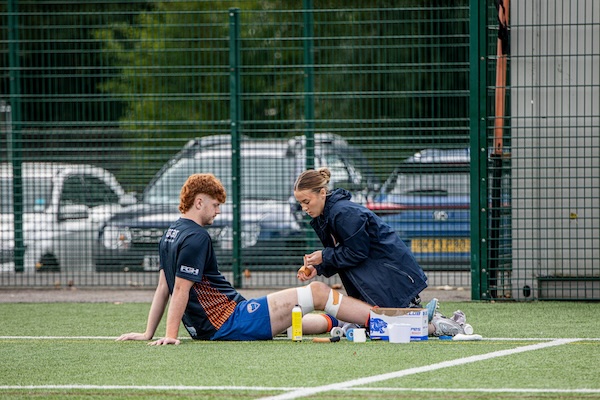
But with the rise in injury rates at all levels of play in the past 20 years, another question to ask is: are they lifting too much?
Who knows what too much is? But there is no shortage of evidence that weight lifting can do harm to athletes.
Long time highly respected NFL Strength Coach Mark Asanovich evolved his position over the years. "When i was a traditionally-based practitioner," Coach said, "I had injuries in the weight room as a result of the training I was prescribing. I was hurting kids."
He recognized the fact that weight lifting creates internal shearing forces that create minor accumulating injuries over time.
And even though those minor insults may not be obvious immediately, eventually it's going to show up on the field of play.
"The coaches will say the injury happened on the field”, Asanovich said, "but it didn't, it started in the weight room. They're still not making the connection."
But hey, athletes gotta lift to get bigger and stronger, right?
And they will get bigger and stronger. Yet, after almost 90 years, there is no scientific evidence that the getting bigger part contributes to the stronger part.
But it's easy to see why we would think this is true.
Athletes are typically young, and many of them are still going through the maturation process which is going to increase their size and strength at the same time anyway.
So do athletes even need to get bigger?
Not really. They already have physical gifts -- strength, power, coordination, quickness -- that make them good at whatever they want to do.
As Bo Jackson showed us, some of the best to ever lace 'em up never lifted any weights and were flat out better than all the others who were lifting weights.
I'm more interested in answering the question: "Is there a better way to get performance-enhancing benefits without compromising performance?"
In the 2021 INVERSE article titled Can Athletes Weight Lift Too Much? Tom Brady's Workouts Trigger a Debate, a review of the historic concern in sports history about the potential adverse side effects of weight lifting for athletes yielded this conclusion:
"...the key, then, feels like minimizing injury while maximizing performance: programming an in-the-gym workout that is not felt on the field. But those programs are hard to program, and don't come off the rack, and chafe with some sports organizations rigid philosophies."
Well, there's an alternative approach that solves these goals: it's as simple as just a few seconds of isometric effort.
Here's why:
Eliminating injury in the gym is easy. On a viiivPRO, you lock into a strong joint angle then give your best effort for a few seconds with very little joint movement. No micro trauma or inflammation to recover from.
Practice and games create enough of that already.
Performance enhancing workouts should not add to the recovery process. The athlete who masters this aspect of preparation will automatically have an advantage from week to week and deep into the season.
Difficult to program such a workout? Hardly. A caveman could do it.
It could also be mass replicated to service dozens of athletes with assembly line efficiency.
Now, would it clash with rigid coaching philosophies? Probably. Change is difficult but positive results grab attention.
Regarding performance, athletes basically need two things: movement skill and power.
Game-skills-at-game-speed is what practice is for. Improving power is where viiiv can offer more help than weight lifting.
Here's why:
I know the videos of players squatting 600 LBS are impressive, but that load isn't close to their true force producing capability. You've got to choose a weight that can be moved through a weaker part of the range of motion.
Will they benefit from moving that load? Absolutely. But there's a cost.
With 600 LBS on his back, the total vertical force into the floor of a 220 LB lifter is 750 LBS. Internal compressive force acting on the knee joints at the thighs-parallel position can be 7.5 times the load lifted, or 4,500 LBS with significant shearing forces.
When exerting 600 LBS of horizontal force on the viiivPRO with knees starting at about 60 degrees flexion, internal knee joint compression force can be around 750 LBS.
However, as the knees slightly extend as force production increases, that number declines. In addition, lower shearing forces at the start continue dropping to minimal.
Big difference in knee joint stress.
Now, anyone capable of squatting 600 LBS is probably capable of a 3,000 LB leg press on the viiivPRO. This of course will drive up knee compression force but it will still come with far less risk than squatting a barbell through a full range of motion. And it creates far more neurological impact in just a few seconds.
Remember, it's not about the load you can move, it's about the load you can create against something that doesn't move.
Exposure to the highest loads possible leads to far greater neurological adaptations.
Compared to concentric (lifting) and eccentric (lowering) contractions, it has been scientifically demonstrated that isometric contractions yield far greater changes in voluntary muscle activation.
Think of this as raising your ceiling, or getting a new "gear" to shift into.
Not only is creating a high load important, getting to that load quickly -- rate of force production -- is what athletics is all about.
The rate of force production is a huge determinant of motor unit recruitment and firing rates. In fact, a 3-4 times larger fraction of the motor unit pool is engaged, and maximum firing rates are highest in producing a fast contraction.
The cool thing is, movement isn't necessary to achieve a high rate of force production.
On a viiivPRO, you can create tremendous force quickly without any movement and get all the performance enhancing benefit with incredibly low risk.
You can also see your rate of force production in the software.
Now, quickly back to increased voluntary activation (VA): Not only do high loads lead to the greatest increases in VA, at sub-maximum efforts your VA actually decreases. This means you don't need to expend as much effort to do the same given workload; your "fuel efficiency" improves.
Essentially, you get a larger gap between your floor and ceiling. This raises the fatigue threshold and increases capacity; the ability to do a skill over and over again.
If an athlete can save energy and delay fatigue as competition duration increases, this becomes a huge competitive advantage.
And once again, athletes can get this with very little risk to joints and soft tissue.
The point here is not to pick on weight lifting. It's to point out that there is an option that can still get athletes performance-enhancing results without the inherent downside of lifting weights that can negatively affect performance.
Athletes can continue to go with what they know, or they can try something different.
Either way is a gamble, but a new approach just may be worth it.