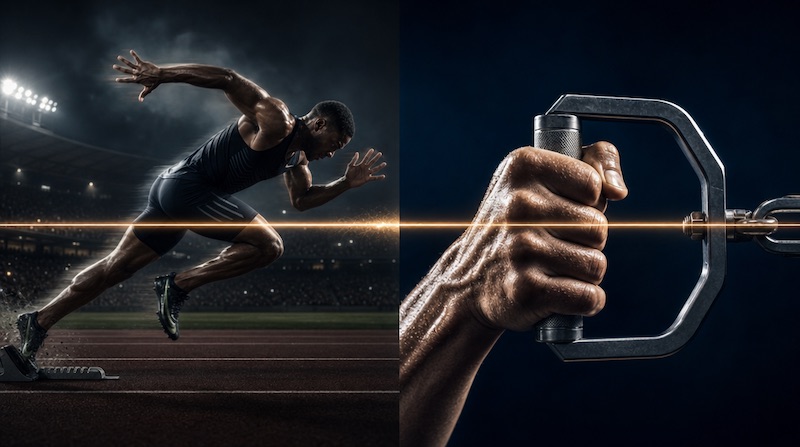
The viiivPRO is changing lives in 10 different countries (and counting). Customers, clients and patients feel a positive difference. It’s impossible not to.
Unfortunately, no matter where it is, there will always be the same common frustration expressed.
Here’s a quote from one of our customers:
“What we are finding is that the clients/patients are obsessed with beating their last numbers. If they don't, they get very disappointed, regardless of what we say and explain to them.”
I share your frustration.
This is completely normal.
It shows me our innate competitive fire persists everywhere in the world, and it will continue to drive all of those who choose to persevere to their highest level of physical capacity as they age.
Although it is a difficult expectation to manage, I think this is a good thing.
I'll share how I approach this. Hopefully the following will help you deal with these conversations.
First, I like to get this out of the way on day one:
"You aren't going to beat your personal best score every time you come in here," is what I tell everyone. "It's not necessary for success and it's not possible," I add.
The distinction that most exercising people have a hard time understanding is that with isometrics we are working at, or near our ceiling of neurological capability.
This is lizard brain stuff. We are dealing with the reticulospinal tract of nerves; it's a primal thing.
To raise our ceiling we have to bite, scratch, and claw our way to increased neurological strength and efficiency. We need to accumulate sensory input in the brain before motor output will change.
This can take time -- weeks, months, even years.
So here's what I use to put things in proper perspective for clients:
Sprinting is the ultimate expression of neurological strength, power, and efficiency.
Sprinters rarely beat their personal best because achieving a top-level sprint time requires a perfect convergence of physical, technical, and environmental factors, alongside immense physical, psychological, and CNS strain.
A record time requires an at-the-time impossible mix of total recovery, elite competition, and optimal conditions, and it is almost impossible to replicate this all the time.
Going through a series of stations on the viiivPRO is not exactly the same neurological load as a sprint, but it is similar. And it's almost impossible to replicate the convergence of factors that contribute to your strength every single time.
Contrast that with conventional exercise which typically doesn't operate anywhere near a challenging neurological load.
What effort level do most people hover around - 30, 40, maybe 50 percent of their best effort?
There is a built-in margin for FAKE progress.
Give 60% effort, or add 10 pounds to the barbell tomorrow and it can look like you're improving when in actuality you're just inching up in the range of capability you already have.
It’s NOT REAL PROGRESS.
Raising your ceiling is real progress.
There's a big difference between perception of effort and intensity. The former is subjective. Most people believe that if it feels difficult then it's a good workout. But with the viiivPRO it is objective; it can be measured on the viiivPRO, which is literally a neurological lie detector.
So let's be realistic.
If you don't beat your personal best today it's because the factors that contribute to your strength converged differently than they did yesterday.
It's just life.
We aren't perfect machines.
So accept it.
It doesn't mean you aren't making progress.
You're just making progress in a different way.
Chasing new personal bests is what keeps your nervous system performing at its highest level. It doesn't matter if you beat your top number.
It's the chase; the intensity; the intention that matters. That's what keeps your nervous system from getting lazy and keeps your physical capacity younger, longer.